Description
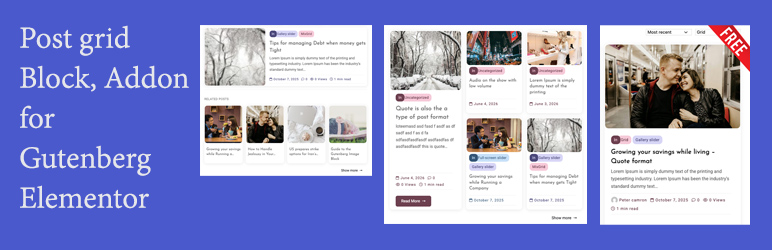
PMT PostGrid for block editor with elementor support adds a live, configurable post grid to your site — as a block-editor block, an Elementor widget, or both. Both builders share the same underlying render function, so a grid built in one looks identical to a grid built in the other, and every setting behaves the same way regardless of which editor you use.
👉 Plugin Demo | Documentation | Plugin detail | Get Pro 👈
Three layouts
- Design 1 — a standard responsive grid (2-6 columns, any number of posts).
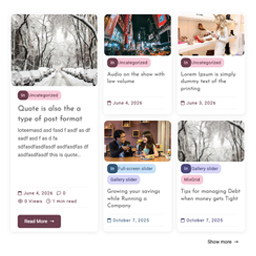
- Design 2 — a golden-ratio featured layout: one large featured post alongside a 2×2 grid of four smaller posts.
- Design 3 — a stacked list, each post split into an image and content column at the golden ratio, with an optional alternating image side.
Query controls
- Filter by category, author, or hand-pick specific posts by title.
- Exclude specific posts from the results.
- Order by date or comment count.
- Set columns and post count (Design 1).
- A live, front-end category dropdown lets visitors instantly switch which category is shown, with no page reload.
Content controls
- Toggle featured image, excerpt (with adjustable word length), tags, and category badge independently.
- Auto-colored category badges — each category is assigned a distinct color automatically, no configuration required.
- Optional « Read more » button and an optional main section title, both independently configurable.
- Reorder each card’s elements (image, category, title, excerpt, meta, tags) via a simple drag-to-reorder list.
Style controls
- Column and row spacing, image corner radius, card corner radius.
- Full box-shadow control (offset, blur, spread, color, inset).
- Optional card border (width, style, color).
- Title font size, with an automatic scale for the smaller cards in Design 2.
- Left/center/right text alignment.
« Show more » button
Automatically appears when there are more matching posts than the grid currently displays, linking to the relevant category archive (or your site’s main blog page) in a new tab.
Built to stay in sync
Every setting is wired through shared PHP functions rather than duplicated per builder or per layout, so a fix or feature added in one place applies everywhere — Design 1, Design 2, Gutenberg, and Elementor can’t drift out of sync with each other.
Developer hooks
This plugin fires several apply_filters() hooks, so themes and other plugins can extend or override its behavior without editing its files directly (changes to plugin files are lost on update; filters aren’t).
pmtpofob_post_grid_args
Filters the fully-merged settings array before anything is rendered — runs before the design is even dispatched, so it can change $args['design'] itself or override any individual setting. Fires once per grid instance, covering every design and both builders.
apply_filters( 'pmtpofob_post_grid_args', array $args )

add_filter( 'pmtpofob_post_grid_args', function( $args ) {
    $args['showExcerpt'] = true; // Force excerpts on, site-wide.
    return $args;
} );
pmtpofob_post_grid_query_args
Filters the WP_Query arguments right before the query runs — add a meta_query, a tax_query, restrict/expand post types, etc.
apply_filters( 'pmtpofob_post_grid_query_args', array $query_args, array $args, string $design )

add_filter( 'pmtpofob_post_grid_query_args', function( $query_args, $args, $design ) {
    $query_args['meta_key']   = 'featured';
    $query_args['meta_value'] = '1';
    return $query_args;
} );
pmtpofob_post_grid_card_html
Filters a single rendered card’s HTML before it’s returned. Fires for every card, in every design.
apply_filters( 'pmtpofob_post_grid_card_html', string $html, int $post_id, string $variant, array $args )

$variant is `'full'` (Design 1 / Design 2's Column A), `'simple'` (Design 2's Column B), or `'row'` (Design 3).
pmtpofob_post_grid_category_color
Filters the color pair (array( 'bg' => '#hex', 'fg' => '#hex' )) used for a category’s badge, meta text, tags, and Read more button. Override the auto-rotated palette with your own brand colors.
apply_filters( 'pmtpofob_post_grid_category_color', array $color, int $term_id )

add_filter( 'pmtpofob_post_grid_category_color', function( $color, $term_id ) {
    if ( 5 === $term_id ) { // Your "News" category's term_id.
        return array( 'bg' => '#FFE0E0', 'fg' => '#8A1F1F' );
    }
    return $color;
}, 10, 2 );
pmtpofob_post_grid_output
Filters the complete rendered output of a grid instance right before it’s returned — the entire thing: wrapper, header, dropdown, every card, Show more button.
apply_filters( 'pmtpofob_post_grid_output', string $html, array $args, string $design )
pmtpofob_post_grid_structured_data
Filters the schema.org ItemList array before it’s serialized to JSON-LD — add/remove fields, or return an empty array to suppress it entirely for a specific instance.
apply_filters( 'pmtpofob_post_grid_structured_data', array $schema, array $items )
Captures d’écrans


Blocs
Cette extension fournit 1 bloc.
- Post Grid (Postmagthemes)
Installation
- Upload the plugin folder to
/wp-content/plugins/, or install directly through the Plugins screen in your WordPress admin. - Activate the plugin.
- Gutenberg: in the block editor, add the « Post Grid » block and configure it in the sidebar.
- Elementor: with Elementor active, drag the « Post Grid » widget into your layout and configure it in the left panel. The widget only registers itself if Elementor is installed and active — no errors or dependency warnings if it isn’t.
FAQ
-
Does this work with both Gutenberg and Elementor?
-
Yes — as two separate integrations (a block and a widget) built on the same shared rendering code, so results are visually identical either way. You can use either one, or both on different pages of the same site.
-
Is the grid static or does it update automatically?
-
It’s fully dynamic. The grid queries your posts live on every page load — publish a new post, or edit an existing one, and the grid reflects that automatically. Nothing needs to be re-saved.
-
Does it work without Elementor installed?
-
Yes. The Gutenberg block works entirely independently. The Elementor widget only registers itself if Elementor is active; with Elementor inactive or not installed, that part of the plugin is simply inert.
-
How are category badge colors chosen?
-
Automatically. Each category is deterministically assigned one of several preset colors based on its ID, so the same category always gets the same color across your site with no setup required.
-
Can I show a specific set of posts instead of a category feed?
-
Yes — use the « Specific posts » picker to choose exact posts by title. When any are selected, they completely override the category/order settings and display in the order you picked them.
-
Can I customize this plugin’s behavior from my theme or another plugin, without editing its files?
-
Yes — see « Developer hooks » below.
-
What happens to my data if I delete this plugin?
-
Deleting the plugin (not just deactivating it) removes everything it stores: its own settings, its view-count tracking, and the short-lived cache used by the live front-end filter. It does not touch any block or widget you’ve placed in your pages/posts — that content is yours and stays exactly as it is, so if you reinstall the plugin later, your grids come back too.
Avis
Il n’y a aucun avis pour cette extension.
Contributeurs/contributrices & développeurs/développeuses
« PMT PostGrid for block editor with elementor support » est un logiciel libre. Les personnes suivantes ont contribué à cette extension.
Contributeurs
“PMT PostGrid for block editor with elementor support” a été traduit dans 8 locales. Remerciez l’équipe de traduction pour ses contributions.
Traduisez « PMT PostGrid for block editor with elementor support » dans votre langue.
Le développement vous intéresse ?
Parcourir le code, consulter le SVN dépôt, ou s’inscrire au journal de développement par RSS.
Journal des modifications
2.42.4
- readme updated. css updated. hide 0 post category in output.
2.42.3
(renamed slug/text domain to pmt-postgrid-block-editor-elementor-support, prefix changed from pmt_/pmt- to pmtpofob_/pmtpofob-, added Requires Plugins: elementor; verified Elementor-specific code already loads only when Elementor is active and fails gracefully otherwise — no functional change needed; fixed a stale old-plugin-name reference in uninstall.php’s header comment and in CHANGELOG.md’s own intro line; prefixed uninstall.php’s own $site_ids/$site_id variables to pmtpofob_site_ids/pmtpofob_site_id — these sit at the file’s top-level script flow rather than inside a function, closer to global scope than an ordinary function-local variable; checked the rest of the codebase for anything similar and found nothing else in that category)
* proper escaping done in many places.
* Added two new panels/sections in both builders, positioned right after Reset: « Document » (links to the plugin’s documentation) and « Buy Premium » (links to the Pro version’s download page).
2.42.2
- Fixed a real gap in the JSON-LD structured data’s
</script>breakout guard, inpmt_post_grid_render_structured_data()— the only place this plugin generates structured data, which every design (1/2/3) and both builders funnel through. The guard usedstr_replace(), which only matches the exact lowercase string</script>; browsers close<script>tags case-insensitively, so a post title containing e.g.</SCRIPT>would have slipped through and closed the tag early, letting whatever followed execute as live JavaScript. Switched tostr_ireplace()(case-insensitive). Fixed at the single source function rather than patched at each of the four call sites that echo its output, since escaping there isn’t really the issue — the string those call sites return is a deliberate mix of trusted markup and already-safe dynamic content, and the actual defect was in how the JSON-LD segment gets sanitized before that string is even assembled.
Renamed the plugin again: « PMT PostGrid for block editor with elementor support » (was « Post Grid Block and Addon for the Block Editor and Elementor »). WordPress.org’s plugin review flagged the previous name as too generic and overlapping existing « Post Grid » plugins, with « Elementor » not clearly framed as a third-party integration. New name puts a distinctive brand prefix (« PMT ») first, per WordPress.org’s own stated pattern for trademark framing (brand name first, generic description in the middle, third-party trademark at the end as « with X support »). Requested slug/Text Domain (pmt-post-grid) is unchanged — it already matched the plugin’s existing internal folder name and every internal identifier, so this was a display-name-only update, not a full text-domain migration.
2.42.1
- Renamed the plugin: « Post Grid Block and Addon for the Block Editor and Elementor » (was « …for Gutenberg and Elementor »). WordPress.org’s plugin upload validator rejected the previous name — « gutenberg » is a restricted term and cannot appear in a plugin’s name/permalink at all, regardless of context. Updated consistently everywhere the name appears: the PHP
Plugin Name:header, the readme title, the admin menu title, and the admin page heading.
2.42.0
- Removed the « Leave a review » admin notice entirely (added in 2.38.1) — the activation hook, its self-healing admin_init fallback, the review-action handler, the allowed_redirect_hosts filter it needed, the notice itself, and its two options (
pmt_post_grid_activated_time,pmt_post_grid_review_dismissed) are all gone, including their cleanup entry inuninstall.php— this plugin was never distributed with the feature active, so there’s no legacy data anywhere to account for.
2.41.3
- Switched the « Leave a review » notice’s external redirect (the « Ok, you deserve it » action) from
wp_redirect()towp_safe_redirect(), and addedwordpress.orgtoallowed_redirect_hostsso the off-site redirect to the actual WordPress.org review page still works correctly —wp_safe_redirect()silently blocks redirects to any host not on that list by default. - Documented (via
phpcs:ignore) whyuninstall.php‘s two bulk-delete queries intentionally don’t usewp_cache_get()/wp_cache_set()/wp_cache_delete()— both are one-time, pattern-based bulk deletes with no « next read » for a cache to ever serve, since they run exactly once, right before the data they touch ceases to exist entirely.
2.41.2
- Removed all remote image references from the « Post Grid » admin products page — fixes a PluginCheck.CodeAnalysis.Offloading.OffloadedContent finding. Plugin icons (previously loaded from ps.w.org) and theme screenshots (previously loaded from WordPress.org’s own asset CDN) are gone entirely; the page is now text-only (name, description, install count, link) for both « Our Plugins » and « Our Themes. » Offloading any image/script/style to a remote host is disallowed regardless of whose server it is, including WordPress.org’s own — not something that could be fixed by simply hosting the same images locally either, since this plugin has no way to fetch and bundle real third-party image assets as part of its own build process.
2.41.1
- Switched date/time output to late escaping (escaping applied inline, right at the point of output, rather than pre-assigned to a variable earlier and echoed later) — fixes a WordPress.Security.EscapeOutput.OutputNotEscaped PHPCS finding at pmt-post-grid.php:1015, and two further occurrences of the same underlying pattern (the meta-info date entries in the ‘row’ and ‘full’ card variants) that a targeted search turned up. Not a security fix — the data was already safe either way — but the correct, current best-practice pattern per WordPress’s own coding standards, and easier to audit.
2.41.0
- Removed the last remaining static inline styles — the « Post Grid » admin products page (Our Plugins / Our Themes) was built quickly with
style="..."attributes throughout, which is exactly the pattern flagged and fixed elsewhere in this plugin earlier (the same distinction applies: static values that never vary should be a CSS class, not an inline style). Moved everything into a new dedicated stylesheet,admin/products-page.css, enqueued only on that one admin page — never loaded anywhere else, including the front end. Every remaining inline style in the plugin is now confirmed genuinely dynamic (per-category colors, per-instance CSS custom properties) and can’t be a static class.
2.40.2
- Found the actual root cause of the block staying under « Widgets »: Gutenberg blocks have two separate registrations — server-side PHP (
register_block_type(), which 2.40.0/2.40.1 correctly updated) and client-side JS (wp.blocks.registerBlockType()inblock/index.js, which controls what the block inserter UI actually displays). The JS registration had its own hardcodedcategory: 'widgets', completely overriding the PHP side regardless of how correctly that was configured. Fixed tocategory: 'postmagthemes', matching the PHP registration. Both the category being registered (PHP, fixed in 2.40.1) and the block being assigned to it (JS, fixed here) were necessary together — neither alone was sufficient, which is why 2.40.1 alone didn’t resolve it.
2.40.1
- Fixed the « Post Grid by Postmagthemes » Gutenberg category not actually taking effect (the block still showed under « Widgets » despite 2.40.0’s fix). Root cause, confirmed against a real-world plugin doing the same thing correctly: the filter was registered at the default priority, which risks another plugin’s own block-categories filter running afterward and rebuilding the array without preserving this addition. Now registered at a very high priority (999999999, so it runs last) and on both the current filter name (
block_categories_all) and the older, still-supported one (block_categories).
2.40.0
- Added a « Post Grid by Postmagthemes » category to the Gutenberg block inserter — the block previously had no explicit category, so it fell back to the generic « Widgets » bucket. Renamed Elementor’s matching category from « Postmagthemes » to the same « Post Grid by Postmagthemes » title for consistency (its slug is unchanged, so nothing else needed updating there). Both builders now share the same category slug (
postmagthemes), so any future block/widget from this plugin can be added to the same category in both places just by referencing that slug.
2.39.0
- Added
uninstall.php— WordPress’s standard, documented mechanism for plugin cleanup, only ever run when a user clicks « Delete » on an already-deactivated plugin (never on simple deactivation). Removes every piece of persistent data this plugin writes: the review-notice options (pmt_post_grid_activated_time,pmt_post_grid_review_dismissed), the_pmt_viewsview-count meta on every post, and the short-lived per-instance transients used by the live front-end filter. Handles multisite properly (loops every site on the network viaswitch_to_blog(), rather than only cleaning the current site). Deliberately leaves actual block/widget content in posts/pages untouched — that’s the user’s own content, not this plugin’s internal data.
2.38.4
- Moved the category post count to the correct place: the editor’s own Category control (both builders, e.g. « Business (12) » when choosing which category to query), not the live front-end filter dropdown visitors see — reverted that one back to plain names, since that was never the intended location.
2.38.3
- The live front-end category filter dropdown now shows each category’s post count alongside its name, e.g. « Business (12) » — uses the
countproperty WordPress’sget_categories()already returns, no extra query needed.
2.38.2
- « Our Themes » on the Post Grid admin page now shows only the 8 most recently updated themes, reordered by actual recency (per postmagthemes’ real Theme Trac update history) rather than install count. Added a « More themes » button linking to the real WordPress.org author page (
wordpress.org/themes/author/postmagthemes/) for the full 14.
2.38.1
- Added a « Leave a review » admin notice, shown on every wp-admin page (hooked on
admin_notices, which fires globally regardless of which menu item is open — not scoped to this plugin’s own settings page), once an administrator has had the plugin active for more than 7 days. Three actions, all plain nonce-verified GET links, no JS/AJAX: « Ok, you deserve it » (dismisses permanently, sends to the WordPress.org review page), « Nope, maybe later » (pushes the 7-day threshold forward another 30 days), « I already did » (dismisses permanently, no external visit). Includes a self-healing fallback so existing installs (not just fresh activations) get the countdown started too.
2.38.0
- Added a new top-level « Post Grid » admin menu page showing postmagthemes’ other WordPress.org products — « Our Plugins » (PostmagThemes Demo Import, WP Theme Statistic) and « Our Themes » (all 14 published theme, with screenshots). Every name, link, and install count is real, sourced directly from postmagthemes’ actual WordPress.org profile, not placeholder content.
2.37.2
- Fixed « Show author » being missing from « Reset all settings » in both builders — the toggle was fully wired up when added in 2.37.0, but the two hand-maintained reset-defaults maps (Gutenberg’s
PMT_DEFAULT_ATTRIBUTES, Elementor’sgetElementorDefaults()) were never updated to include it. Audited both maps against every actual control/attribute to confirm this was the only gap.
2.37.1
- Fixed the author avatar sitting visibly lower than the date/comments/views icons in meta info. The 2.37.0 fix only handled alignment inside the author item (avatar vs. its own text) — it missed that
.pmt-extra-info(the outer row all meta items share) had noalign-itemsset at all, defaulting tostretch. Every item stretched to match the tallest sibling (now the 20px avatar), but each item’s own content stayed wherever it naturally sat within that stretched box rather than centering against its siblings. Addedalign-items: centerto.pmt-extra-infoitself, both files.
2.37.0
- Added author (avatar + name, linked to the author’s archive) as a new meta info item, in both builders — always the first item in meta info, ahead of date/comments/views/reading time. New « Show author » toggle, positioned first in the Meta info panel/section, default on. Uses WordPress’s own
get_avatar(), so it respects whatever Gravatar/avatar setup is already configured site-wide.
2.36.1
- Changed view-tracking to match the Pro version’s implementation exactly: cookie-based de-duplication (once per visitor per post per day) instead of the transient+IP/UA-fingerprint approach from 2.36.0; read-then-write increment instead of an atomic SQL
UPDATE; own tracking (_pmt_views) now checked first inpmt_post_grid_get_views(), with third-party plugin keys as the fallback (previously the reverse); and adopted Pro’s fuller bot-signature list (19 patterns, including Slack/Discord/headless-browser bots, vs. 8 previously).
2.36.0
- Added a genuine view-counting mechanism — previously « Show views » only read from common view-count meta keys, with nothing in the plugin actually incrementing any of them (no theme edits needed here, since this hooks into WordPress’s own
template_redirectaction rather than a template file). Writes to its own dedicated_pmt_viewsmeta key, which is deliberately the lowest-priority keypmt_post_grid_get_views()checks — so if a dedicated view-counter plugin is already active and tracking one of the other recognized keys, that count is what displays; this just runs harmlessly in the background as a fallback for sites with no other view tracking at all. Includes real safeguards: only counts genuine single-post visits (never pages/previews/admin), skips logged-in staff (edit_postscapability) so the site’s own authors don’t inflate their own counts, filters a handful of common bot/crawler user agents, de-duplicates by visitor for one hour via a transient so refreshes don’t each count as a new view, and increments via a single atomic SQLUPDATErather than read-then-write, avoiding a race condition where near-simultaneous visitors could lose an increment.
2.35.2
- Fixed a real race condition in the Elementor « Reset all settings » button: the listener was only ever bound inside a
$(window).on('elementor:init', ...)handler, which permanently misses the event ifelementor:inithad already fired before this script loaded (script load order isn’t guaranteed relative to when Elementor finishes its own init — this can shift with any WordPress/Elementor update). The button would render and be clickable, but silently do nothing, since the listener that should have caught its event was never actually registered. Now checks synchronously whether Elementor has already initialized and binds immediately in that case, falling back to the event listener only if it genuinely hasn’t initialized yet.
2.35.1
- Removed Beaver Builder support (added in 2.35.0) — back to Gutenberg and Elementor only.
2.35.0
- Moved the Elementor « Reset all settings » button out of the bottom of the Typography section into its own dedicated « Reset » section, right after Typography — it was easy to miss buried at the end of an unrelated section. Gutenberg’s placement (end of the Typography panel) is unchanged, since its own panel structure already makes it reasonably discoverable there.
2.34.4
- Fixed the real root cause of the Elementor reset button: it was updating the underlying settings correctly (panel controls showed the new values), but doing so by mutating the raw Backbone settings model directly — which silently skips Elementor’s live-preview refresh, undo/redo history, and the « document modified » flag that enables the Publish/Update button. Switched to Elementor’s documented Commands API (
$e.run('document/elements/settings', {...})), the same command real user edits go through, so the reset now correctly updates the live preview and enables Publish/Update, and the reset actually persists on save. Removed the manual repeater-collection reset workaround from 2.34.2/2.34.3 — no longer needed, since the Commands API handles all setting types (including repeaters) the same way the real UI does.
2.34.3
- Added diagnostic console logging throughout the Elementor « Reset all settings » script (
block/elementor-editor.js) — every step now logs what it found or why it’s aborting, and the actual reset is wrapped in try/catch so a real error is now clearly attributable to this script rather than indistinguishable from unrelated console noise (e.g. Elementor’s own AI/Cloud-Kit background requests). Console-only, no visible behavior change if it was already working.
2.34.2
- Added a « Reset all settings to default » button to the bottom of the Typography panel/section, in both builders:
- Gutenberg: a plain button + confirmation prompt that calls
setAttributes()with every attribute’s registered default in one go — straightforward, since Gutenberg attributes are just React state. - Elementor: a BUTTON control firing a Backbone event, handled by new editor-only JS (
block/elementor-editor.js, never loaded on the front end) using Elementor’s Container API. Repeater controls (layoutOrder,layoutOrderDesign3) are reset via their own nested Backbone Collection specifically, not just the parent settings model — Elementor repeaters maintain their rows separately from the main settings, so a blanket reset on the parent alone doesn’t reliably refresh the repeater’s own view. - Every default value in both reset maps was cross-checked line-by-line against the actual PHP-registered defaults (shared PHP defaults, Gutenberg’s attribute schema, Elementor’s control defaults) — all match exactly.
- Gutenberg: a plain button + confirmation prompt that calls
2.34.1
- Trimmed the bundled Font Awesome stylesheet down to only the 4 icons this plugin actually uses (calendar, comment, eye, clock) — cuts
fontawesome.cssfrom ~83KB to under 1KB. - Removed unused solid/brands/v4-compatibility webfont files from the package; only the regular-weight font actually used by the plugin ships now.
- Fixed the
<time>element’sdatetimeattribute to use a machine-readable ISO 8601 date instead of the human-formatted display date.
2.34.0
- Added two independent toggles (both builders), in the Layout panel/section right after the Design dropdown: « Show sort filter » and « Show category filter » — lets you hide either (or both) of the live front-end dropdowns without disabling the other. Both still respect the existing rule of hiding automatically when Specific posts is active.
2.33.4
- Fixed height not shrinking when related posts are fewer than 4 (with the « Show related post image » toggle off). The empty placeholder slots always kept their
aspect-ratio: 1square shape regardless of the toggle — so even with images off, those empty slots stayed tall, and flex’salign-items: stretchthen forced the real title-only items back up to match them. Empty placeholders now only get the square.pmt-related-post--emptytreatment when images are actually being shown; otherwise they stay unstyled/collapsed, so the whole row (real items and empty slots alike) shrinks together.
2.33.3
- Reverted to 2.33.0 behavior for related post images: the
.pmt-related-post__imagecontainer renders whenever the « Show related post image » toggle is on, regardless of whether that specific post has a thumbnail (default behavior restored). The only condition that shrinks a related post’s height now is the toggle itself being off entirely — in that case the image container never renders at all, so there’s no reserved image space.
2.33.2
- Reverted the
align-items: flex-startadded in 2.33.1 — it stopped stretching entirely, which was wrong for mixed rows (a title-only item next to siblings with images should still stretch to match them). The actual fix was the other half of 2.33.1 (not rendering the phantom empty image div for posts with no thumbnail) — with that in place, defaultalign-items: stretchalready does the right thing on its own: stretches to match a taller sibling when one exists, and naturally stays short when no sibling in the row has an image at all (nothing tall to stretch to).
2.33.1
- Fixed related posts without a featured image taking up more height than just their title. Two causes:
.pmt-related-post__imagerendered whenever the global « Show related post image » toggle was on, regardless of whether that specific post actually had a thumbnail — a post with no image still got an empty<div>reserving a full square’s worth of space viaaspect-ratio: 1. Now only renders when the post actually has a featured image.- Even after fixing that, a title-only item would still stretch to match taller sibling images in the same row (flex’s default
align-items: stretch). Addedalign-items: flex-startto.pmt-related-posts__listso each item’s height is its own, not forced to match neighbors.
2.33.0
- Added
min-height: 40pxto the post title in Design 3 only (.pmt-blog-snippet--row .pmt-title), both files. - Related post titles (Design 3) now trim to 6 words with an ellipsis, matching the existing 9-word trim already used for the main title.
- Fixed a double-escaping bug this surfaced: both title-trim functions passed the HTML entity string
'…'towp_trim_words(), but their output is wrapped inesc_html()at every call site — which encodes the&in…into&hellip;, displaying as literal visible text (« … ») instead of an ellipsis, whenever a title actually got trimmed. Switched both to the actual UTF-8 ellipsis character ('…'), whichesc_html()doesn’t touch. Excerpt trimming (a separate code path usingwp_kses_post(), notesc_html()) doesn’t have this problem and was left unchanged.
2.32.1
- Fixed empty related-post placeholders (fewer than 4 related posts found) no longer showing blank space — the
.pmt-related-postselector had been changed toa.pmt-related-post(both files), restricting the flex/sizing rules to<a>elements only. Real related-post items are<a>tags, but the empty placeholders are<div>elements, so they’d stopped matching the rule entirely and lost theflex: 1 1 calc(25% - 9px)sizing that made them take up their share of the row. Reverted to the plain.pmt-related-postclass selector so both match again.
2.32.0
- Related post cards now get box-shadow, border, and border-radius, using the exact same
--pmt-box-shadow/--pmt-box-border/--pmt-box-radius-top/--pmt-box-radius-bottomCSS vars as.pmt-blog-snippet— no new controls, the existing Style panel/section already governs this. - Related post images now get
margin: 2px 2px 2px 2px, matching.pmt-img-holder. Also removedwidth: 100%from the image while doing this — keeping it would have reintroduced the exact width+margin overflow bug already found and fixed for.pmt-img-holderearlier in this plugin (a block element withwidth: 100%doesn’t leave room for its own margins). The image still fills its container correctly via the parent’s defaultalign-items: stretch, same mechanism.pmt-img-holderalready relies on.
2.31.2
- Related posts now pad up to 4 total with empty placeholder slots (dashed square boxes) when fewer than 4 are found — same pattern already used for Design 2’s Column B. Still renders nothing at all when zero related posts are found (e.g. an uncategorized post).
2.31.1
- Related posts now render after
.pmt-blog-snippetcloses (a sibling of it), not nested inside.pmt-blog-content. - Fixed related post images not actually rendering square. Same CSS specificity trap hit before in this plugin: the general
img {}rule is nested inside.pmt-thumb-blog.pmt-post-grid-block, giving it higher specificity (2 classes + element) than the standalone.pmt-related-post__image imgoverride (1 class + element) — so none of that override’s properties, includingaspect-ratio: 1, were actually taking effect. Moved the override inside the same nested block, matching the existing pattern already used for.pmt-design2-col-a img.
2.31.0
- Added related posts to Design 3: up to 4 other posts sharing that row’s own category, shown below each row’s content (square image + title, image always first). Not part of the reorderable Card element order — fixed position, always last, image before title.
- New controls (both builders), positioned right after Card element order, visible only for Design 3: « Related post title » (a text field for the section label — leave empty to hide just the label), « Show related post image », « Show related post title ».
- Related post titles automatically use one heading level below the parent row’s own title tag (h3 parent -> h4 related, etc.), capped at h6 — not user-configurable, always automatic.
- Related post title size defaults to 80% of the parent title’s size, now adjustable via a new « Related post title size (% of parent) » control in Typography — visible only when Design 3 is selected.
- Fixed a Typography panel/section bug: « Column B title size (% of Column A) » was showing regardless of which design was active, even Design 1 where Column B doesn’t exist. Now only shows for Design 2, matching the new Design-3-only control’s same conditional pattern.
2.30.0
- Added a second live, front-end dropdown — « Most recent » / « Most commented » — sitting in the same row as the category dropdown, as its own separate
<select>(not merged into one list). Same mechanism: an AJAX request re-renders just the grid content, no page reload. Hidden when Specific posts is active, same as the category dropdown. - Both dropdowns now work together correctly: changing one always includes the other’s current value in the request, so switching sort order doesn’t reset an active category filter, and vice versa.
- REST endpoint (
pmt-post-grid/v1/filter) extended to accept anorder_byparameter alongsidecategory. - New shared
.pmt-filter-controlswrapper holds both dropdowns as a group, right-aligned viamargin-left: auto(previously that margin lived directly on the category dropdown’s own wrapper).
2.29.0
- Removed the « Order » (ascending/descending) control from the Query panel/section entirely, in both builders — results are now always descending (newest first, or most-commented first when « Order by: Comment count » is selected). « Order by » itself is unchanged and still configurable. Removed from the shared PHP defaults, Gutenberg’s attribute schema, and Elementor’s control + render() mapping; hardcoded to
DESCin all three designs’ queries.
2.28.2
- Removed another static inline style:
style="color:inherit;"on the meta row’s date/comment links (5 call sites) — entirely redundant, since.pmt-extra-info aalready setscolor: inherit;in the stylesheet (both files). Same category of fix as 2.28.1.
2.28.1
- Removed a static inline style flagged as a WordPress.org compliance concern:
border-radius:var(--pmt-box-radius-top, 0px);was repeated inline on every category badge/label across 6 call sites — moved into the existing.pmt-category-tag__prefix/.pmt-category-tag__labelCSS rules (both files) instead, since it’s the same value every time and doesn’t need to be computed per-post. Genuinely dynamic inline styles (e.g.background/color, which vary per category) are left as-is — those can’t be a static class since the actual color differs per post. Fixed once in the sharedpmt_post_grid_render_card()function, so both Gutenberg and Elementor are covered automatically (there was no separate copy to fix in the Elementor widget file).
2.28.0
- Replaced the opacity-fade loading state (during the live category filter’s AJAX request) with real skeleton placeholders — shimmering gray shapes matching whichever design is currently active (Design 1’s grid/column layout, Design 2’s golden-ratio 1+4, or Design 3’s stacked rows), detected from the existing DOM so no extra data needs passing from PHP. The previous content is restored automatically if the request fails, rather than being left on a stuck skeleton or blank.
2.27.0
- Added JSON-LD structured data (schema.org
ItemList, with a minimalArticleper post: headline, url, image, datePublished, author) for real SEO value — a rich, machine-readable summary of what each grid instance is actually showing. New « Add structured data (SEO) » toggle (both builders, default on) to disable per-instance if your SEO plugin already outputs its own listing schema for that page. Deliberately minimal per-post data — the full/rich Article schema belongs on the post’s own page, not duplicated on the listing page. Newpmt_post_grid_structured_datafilter for developers to customize or remove the schema per instance.
2.26.1
- Changed default Row margin from 30 to 15 (space between rows). Also fixed an inconsistency this surfaced: Elementor’s own Row margin control already defaulted to 15 (with « Default: 15 » in its own description), but three other places — the shared PHP defaults, the Gutenberg attribute schema, and Elementor’s
render()fallback value — all still said 30. All four now consistently say 15.
2.26.0
- Added five developer filter hooks so themes/other plugins can extend this plugin without editing its files:
pmt_post_grid_args(the full settings array),pmt_post_grid_query_args(the WP_Query args, tagged by design),pmt_post_grid_card_html(a single card’s output, tagged by variant),pmt_post_grid_category_color(the auto-rotated color pair, per category), andpmt_post_grid_output(the complete rendered instance). Documented in a new « Developer hooks » readme section with usage examples.
2.25.1
- Removed
aspect-ratio: autofrom.pmt-blog-snippet--row .pmt-img-holder img(both CSS files). - Design 3’s image is now genuinely non-reorderable, not just structurally ignored: it has its own separate « Card element order » setting (
layoutOrderDesign3) with no « Featured image » option in the list at all, in both builders — rather than reusing Design 1’s control (where image was a selectable, if functionally inert, row). Elementor needed a second, independent REPEATER control for this (condition-gated to Design 3), since Elementor’s repeater can’t conditionally hide a single row within a shared control based on another setting’s value.
2.25.0
- Added Design 3: a stacked list of posts, each split into an image and content column at the golden ratio (38.2% / 61.8%), image always its own column. Content order (category/title/excerpt/tags) uses the same shared Card element order as Design 1; meta info is fixed last, same as elsewhere. No « Read more » button in this design — excluded by design, not a toggle.
- New « Number of posts » control specific to Design 3 (separate from Design 1’s, default 3), with the same « Show more » behavior — appears when more matching posts exist than this count, linking to the category/blog archive.
- New « Alternate image side » toggle (Layout panel/section, visible only for Design 3): when on, odd rows show image-left, even rows image-right; off (default) keeps every row image-left.
2.24.1
- Fixed a PHP deprecation warning («
whois deprecated since 5.9.0″) in the Elementor widget’s Author list —get_users( array( 'who' => 'authors' ) )replaced withget_users( array( 'capability' => array( 'edit_posts' ) ) ), the officially recommended equivalent. Gutenberg’s REST-based author fetch (/wp/v2/users?who=authors) was unaffected — that’s a separate, still-supported REST API parameter, not the deprecatedWP_User_Queryone.
2.24.0
- Added an Author filter dropdown (Query section, both builders) — filters the grid to a specific author, alongside the existing Category filter. Ignored while Specific posts is active, same as Category.
- Added an Exclude posts picker (both builders) — the inverse of the existing « Specific posts » picker: instead of showing only chosen posts, checked posts here are removed from whatever the Category/Author/Order query would otherwise return. Also ignored while Specific posts is active (there’s nothing to exclude from an exact list).
2.23.1
- Changed
.pmt-tag-listmargin from10px 0 10pxto5px 0 10px(both files).
2.23.0
- Changed the default card element order to: image, category badge, title, excerpt, tags — with meta info and the « Read more » button always rendering last, in that order, after everything else.
- Meta info removed from the reorderable « Card element order » list entirely (both builders) — it’s no longer draggable/repositionable. It now always renders at a fixed position (right before Read more), regardless of how the remaining elements are arranged.
2.22.4
- Added
line-height: 1;andmin-height: auto;to the category filter dropdown, overriding WP admin’s default select sizing.
2.22.3
- Fixed the category filter dropdown getting overridden by WordPress admin’s own
.wp-core-ui selectstyling in the Gutenberg editor — that selector (class + element) is technically more specific than a lone.pmt-category-filterclass, regardless of CSS load order. Bumped our selector to …